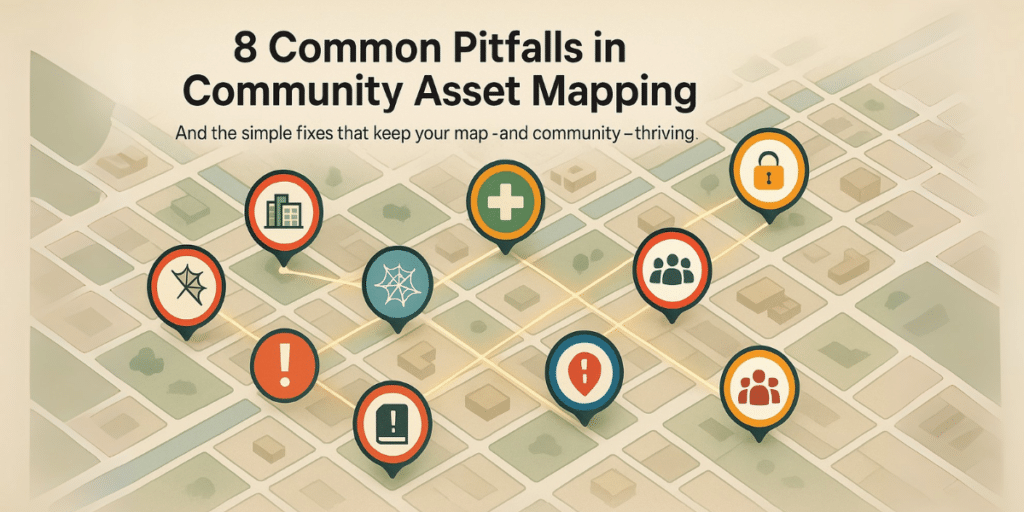
Community-asset mapping can be a launchpad for stronger partnerships and smarter resource allocation—but only if the process is as intentional as the map itself. It is easy to get lost in the forest and lose sight of the big picture if you aren’t careful, especially if you are just getting started for the first time.
Below are eight pitfalls we see again and again in real-world community asset mapping projects, plus pragmatic fixes you can put in place today (including a few ways network and relationship mapping can help).
Table of Contents
1 | Jumping straight to solutions instead of mapping what already exists
The pitfall
Excited teams often skip the quiet, systematic inventory phase and head straight into program design. The Camden Coalition warns that this “duplicates services and wastes precious community resources,” and even alienates potential partners whose work was overlooked.
The fix
- Start every project with a baseline asset inventory and stakeholder survey.
- In PARTNER CPRM, spin up a survey to gather who’s doing what, where, and for whom.
- Use the resulting relationship map to spot true gaps before proposing new programs.
2 | Treating asset mapping as a “one-and-done” exercise
The pitfall
Services open, close, and shift focus constantly. Viewing mapping as a single event turns the product into shelfware within months, limiting the potential value of the project as a whole.
The fix
- Block quarterly refresh cycles in your CRM or project plan.
- Set up reminder workflows so program leads are prompted to update their slice of the data.
- Pin a “Last updated” date on every public-facing map or member profile for transparency.

Get our monthly newsletter with resources for cross-sector collaboration, VNL recommended reading, and upcoming opportunities for engaged in the “network way of working.”
3 | Letting the data go stale
The pitfall
Even large counties who aim to continue refreshing their data admit their maps “can quickly become out-of-date” unless someone owns maintenance. Philadelphia’s DATA Lab likewise stresses the need for continual updates so maps “stay effective”.
The fix
- Assign a data steward for each thematic layer (e.g., food access, youth programs).
- In PARTNER CPRM Pro, assign key users admin powers to update data fields and questions.
- Publish change logs so partners see the living nature of the asset base.
4 | Under-engaging community members (power imbalance)
The pitfall
According to the University of Memphis, over-reliance on outside experts or consultants (and a tendency to “cede power” away from residents) can erode trust and miss hyper-local knowledge.
The fix
- Use participatory workshops or digital crowd-mapping to bring residents in as co-authors.
- Configure PARTNER’s stakeholder survey so respondents can suggest new assets or flag inaccuracies, then moderate inside the platform.
5 | Slipping back into a deficit mindset
The pitfall
Teams trained to hunt for needs often struggle to spotlight strengths first, making an asset frame feel “naïve or too optimistic” instead of viewing it as an opportunity for growth.
The fix
- Open workshops with an asset-based icebreaker (e.g., “What’s working well here?”).
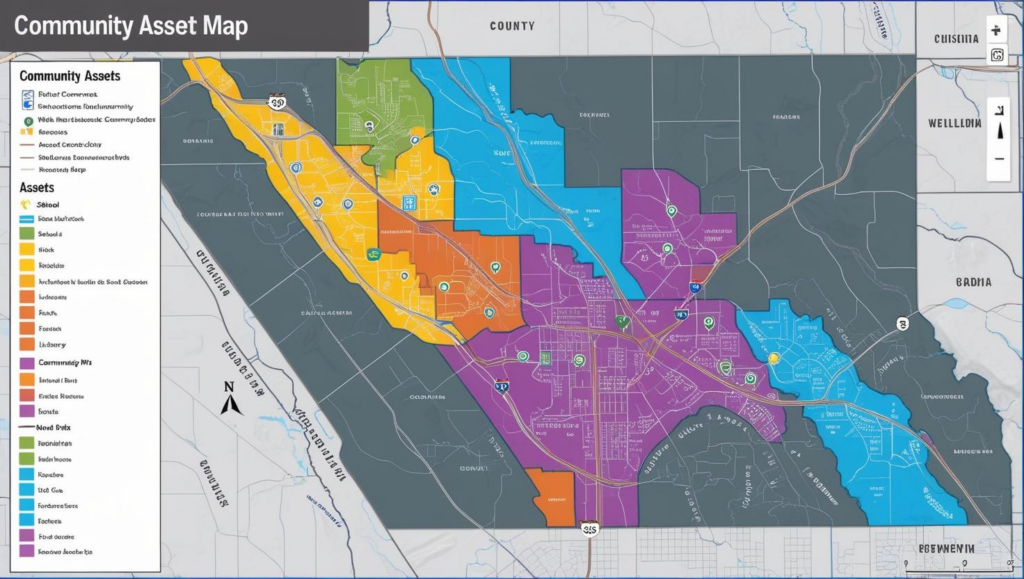
- Color-code map icons so assets, not deficits, dominate the visual.
- Include social-capital metrics (trust, value) from PARTNER CPRM to quantify positives.
6 | Poor logistics in hybrid or in-person sessions
The pitfall
The Philadelphia District Attorney’s Office held a hybrid workshop to map assets, but reportedly struggled with audio issues and time overruns that left no room for reflection. Similar issues with facilitation and convening can severely hamper your asset map.
The fix
- Appoint both an on-site and a virtual facilitator; test microphones and shared whiteboards ahead of time.
- Time-box brainstorming and bake in debrief space.
- Offer a digital fallback for those who prefer to contribute asynchronously.
7 | Ignoring privacy, security, and data-equity red flags
The pitfall
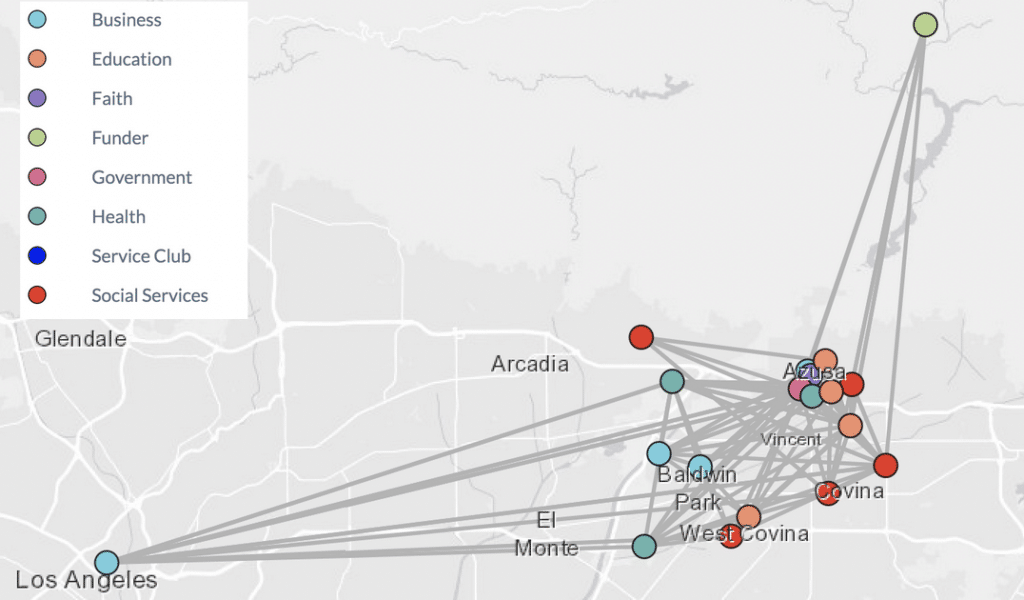
Federal guidance urges teams to separate public and internal versions of sensitive datasets and to evaluate “critical infrastructure security concerns” before publishing. Location-based apps have shown how easily “anonymized” data can reveal personal patterns.
The fix
- Include a field marking members as public, user-only, or private.
- Use role-based access so frontline partners see what they need—nothing more.
- Strip or blur exact geolocation for vulnerable assets (e.g., domestic-violence shelters).
8 | Overlooking informal or “unofficial” assets
The pitfall
Maps that only list registered nonprofits miss block captains, barber-shop influencers, and busy bus stops—the very places trust lives.
The fix
- Add categories for informal leaders and gathering spaces.
- Prompt survey respondents to nominate “people who connect others” and visualize them with PARTNER’s network-centrality scores.
- Cross-reference with social-media groups or WhatsApp chats to capture digital hangouts.
Bringing it all together
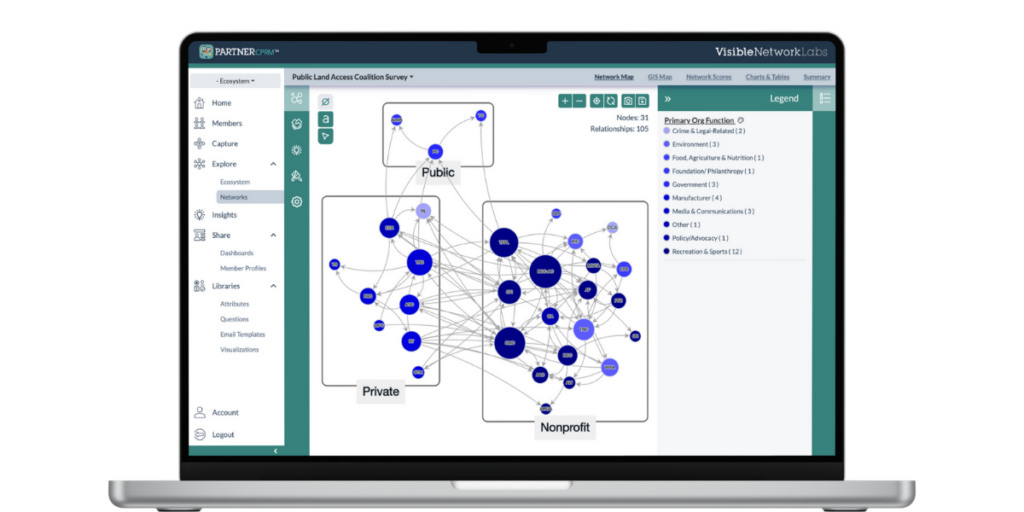
When done well, community-asset mapping becomes a living intelligence system—one that guides equitable investment and fosters collaboration instead of duplication. Sidestepping the pitfalls above will get you most of the way there; leveraging a purpose-built tool like PARTNER CPRM closes the gap by:
- Automating data stewardship (updates, quality checks).
- Embedding stakeholder engagement right inside the mapping workflow.
- Layering network-analysis metrics (trust, value, centrality) on top of geographic data for a richer story.
Ready to see it in action? Book a 30-minute demo or spin up a free workspace to start mapping your first 15 relationships today.
Article Sources
Check out these dependable sources to read more and continue learning about community asset mapping.
- Camden Coalition interview on mapping challenges
- University of Memphis primer on asset-based engagement challenges
- Philadelphia DAO asset-mapping lessons
- Portage County disclaimer on data currency
- NTIA Data-Equity Asset Mapping Guide (privacy & security)
- Lifewire report on geo-privacy risks
- American Press Institute “Asset Mapping 101” (capturing unofficial assets)
Get our monthly newsletter with resources for cross-sector collaboration, VNL recommended reading, and upcoming opportunities for engaged in the “network way of working.”