In complex social systems—coalitions, collaboratives, partnerships, or cross-sector initiatives—network leadership is about more than connection. It’s about positioning, facilitation, and leveraging relationships to drive strategic outcomes. This is where network brokers play a vital role.
At the heart of brokerage is the idea that individuals or organizations who sit at the intersection of different parts of a network have a unique ability to facilitate information flow, bridge silos, and catalyze action. Fernandez and Gould (1989) identified five distinct brokerage roles that offer a powerful framework for understanding how actors operate in different network contexts.
Understanding and leveraging these roles can help network leaders address pain points, increase collaboration efficiency, and achieve strategic goals faster and more effectively.
Table of Contents
What Is Network Brokerage?
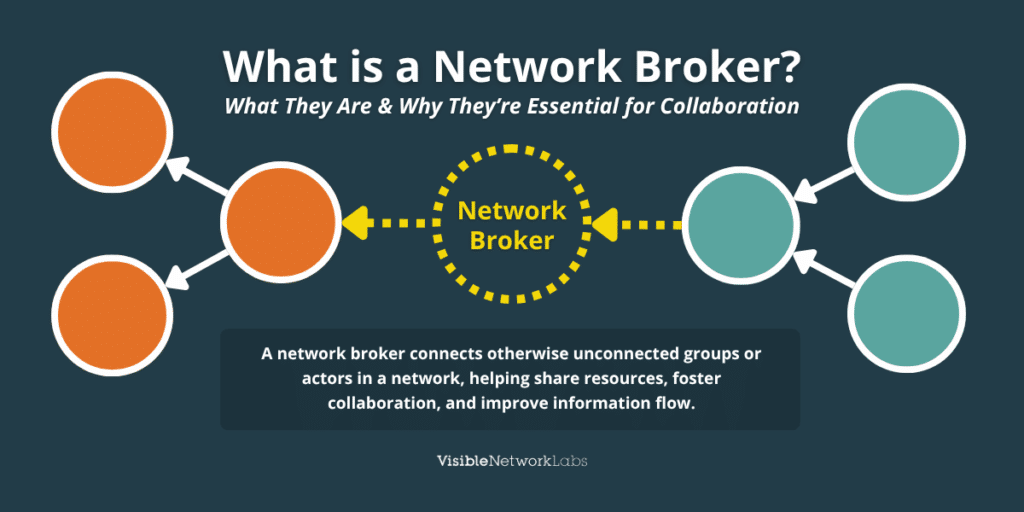
Network brokerage refers to the actions and positions of individuals or organizations that connect otherwise disconnected groups within a network. Brokers can influence access to resources, diffuse ideas, and bridge gaps between communities or sectors that might otherwise remain isolated.
Fernandez and Gould’s typology identifies five ways brokers connect actors across group boundaries. These boundaries could be organizational silos, geographic regions, departments, communities of practice, or even ideological differences.
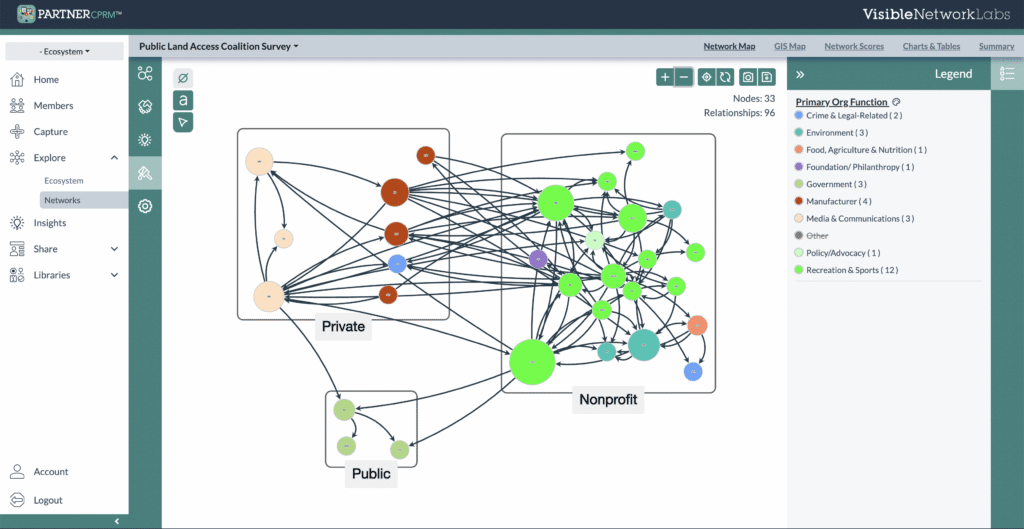
You can identify the different types of network brokers using network science tools and methods. This includes social network analysis and PARTNER CPRM. Here’s an example of what a network broker looks like in action.
The Five Types of Network Broker Roles
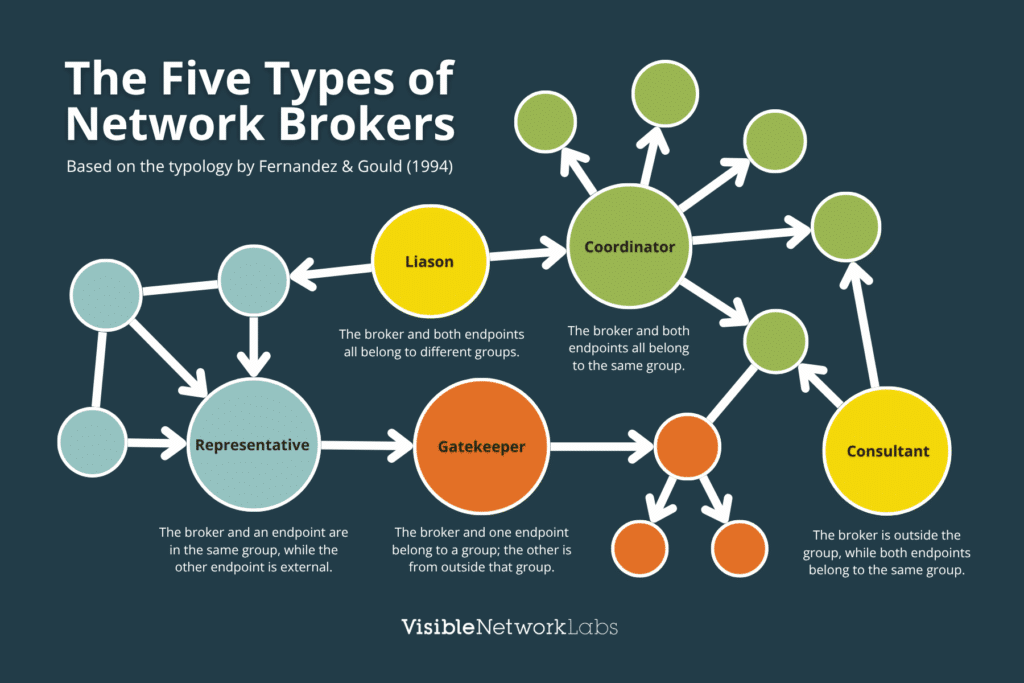
These five roles are based on the typology developed by Fernandez and Gould in their 1994 published article.
1. Coordinator
Within-group brokerage: A coordinator connects people or sub-groups within the same community or organization.
Example: A program manager facilitating coordination between departments in a health coalition.
2. Gatekeeper
Inbound cross-group brokerage: A gatekeeper controls or facilitates the flow of information into a group from outside.
Example: A community engagement officer who translates research findings from academics into language and formats accessible to residents.
3. Representative
Outbound cross-group brokerage: A representative connects their own group to others, advocating outward.
Example: A nonprofit leader who sits on a city-wide advisory board, bringing their community’s voice to policymaking.
4. Consultant
Between external groups (not own group): A consultant links two groups they are not directly part of, often serving as a neutral facilitator.
Example: A third-party evaluator helping public health and criminal justice agencies align shared goals.
5. Liaison
Between-group brokerage, with no group affiliation: A liaison connects two different groups, neither of which they belong to, and often fosters entirely new forms of collaboration.
Example: A funder or cross-sector intermediary convening nonprofits and government agencies who don’t normally interact.
Why These Roles Matter for Network Leaders
Different network structures and goals require different kinds of brokerage. A coalition focused on collective advocacy may rely heavily on representatives, while a regional health improvement network might benefit from liaisons and consultants to bridge sectors and geographies.
By understanding and cultivating these roles intentionally, network leaders can:
Identify structural gaps where brokerage is missing or misaligned
Reduce redundancy and communication breakdowns
Empower strategic actors in the network to lead more effectively
Target interventions for stakeholder engagement, trust-building, or knowledge translation

Get our monthly newsletter with resources for cross-sector collaboration, VNL recommended reading, and upcoming opportunities for engaged in the “network way of working.”
Takeaways and Action Steps for Network Leaders
Here are a few ways to leverage the different types of network brokers that exist in your community.
✅ Map Your Network’s Structure
Use tools like PARTNER CPRM to visualize your network and see where brokers are currently operating—or not. Identify isolated groups, over-burdened connectors, or opportunities to shift roles intentionally.
✅ Assign Broker Roles Based on Strengths and Access
Not everyone is suited for every broker role. Some leaders are naturally strong liaisons who thrive outside group boundaries, while others are trusted gatekeepers with deep insider knowledge. Align roles with personalities, positions, and relational capital.
✅ Support and Train Brokers
Brokers often bear the cognitive and emotional load of translation, coordination, and conflict navigation. Equip them with facilitation tools, communication skills, and authority to act on behalf of the network.
✅ Measure and Monitor Brokerage Impact
Track how brokerage influences information flow, decision-making speed, engagement levels, and equity of voice. Metrics from network analysis (like betweenness centrality) can highlight where brokerage is most effective or needed.
✅ Intentionally Shift Broker Roles Over Time
As your network evolves, so will the need for different broker roles. During formation, you may need liaisons and consultants to build bridges. In a mature stage, coordinators and gatekeepers may become more essential.
Final Thoughts
Too often, networks underperform not because of a lack of talent or resources, but because the wrong people are playing the wrong roles. By strategically deploying the five broker roles identified by Fernandez and Gould, network leaders can unlock the full potential of their partnerships.
Whether you’re working in public health, education, criminal justice, or community development, embracing brokerage is essential to turning networks into engines of action.
Want to Learn More?
Explore how PARTNER CPRM supports network leaders in identifying and activating broker roles with data-driven insights, stakeholder surveys, and dynamic mapping.
📅 Book a demo or start your free account to see how network analysis can empower your leadership.
Get our monthly newsletter with resources for cross-sector collaboration, VNL recommended reading, and upcoming opportunities for engaged in the “network way of working.”